




| soutěž: | Superstudio 2020 |
| 3. místo ve finále | |
| návrh: | Pavla Nesvadbíková |
| Magdalena Uhlířová | |
| Oskar | |
| zadání: | office OMMX |
During a discussion on the competition theme of ‘skin’ in architecture, and how we might interpret this concept, we found ourselves reflecting on the relationship between architecture and the ideology it represents – what, in fact, is the ideology of today’s Czechs? The neoliberal dream of the boundless consumer, with three cars and a villa on the outskirts of Prague? After a period of greyness, uniformity and conformity, the tide turned and people wanted to own things. To have ‘their own’ paradise on earth, where everything would be permitted. But what did they gain? Houses in the suburbs deliberately chosen from catalogues, each so different, and yet all the same. Hidden behind a row of cypress trees and a concrete wall.
So what, then, is their skin? The plaster on the façade? The pseudo-baroque balcony railing? A cheap concrete wall? The ‘beautiful’, decorative skin of the façade clad over an ordinary body of prefabricated blocks, or perhaps the protective skin of the wall, preventing any interaction between the house and its surroundings?
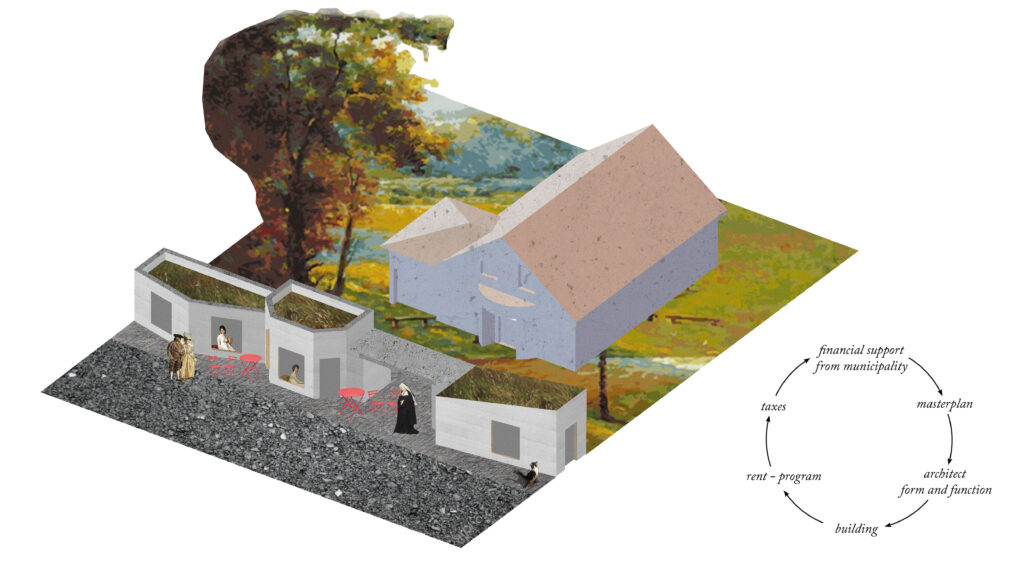
Rather than fighting the suburbs, we propose an alternative way of defining privacy: a critical alternative for residents’ shared spaces – so that the hostile corridors for cars, squeezed between walls, would become streets. We leave the houses as they are and focus on the boundaries – a protective shell which we expand to include a functional core. The principle lies in creating a 2.5-metre-thick layer that interacts with the street and defines a private garden. Into this ‘filter’ we incorporate the missing community amenities – a small shop, a café, a sauna, a solarium, a newsagent’s, space for markets, etc. In return, residents gain a new, prestigious façade that can reflect even the wildest imaginings of the homeowners hiding behind it… and also critically reflect upon them.
Of course, these interventions will not solve the problems of low population density or unsustainable transport in the suburbs. However, this new layer, or principle, can lay the foundations for a more fundamental change in the area in question, which will evolve into a more sustainable satellite town straight out of Ebenezer Howard’s dreams… Because places on the outskirts of the city should not remain ‘peripheral’.